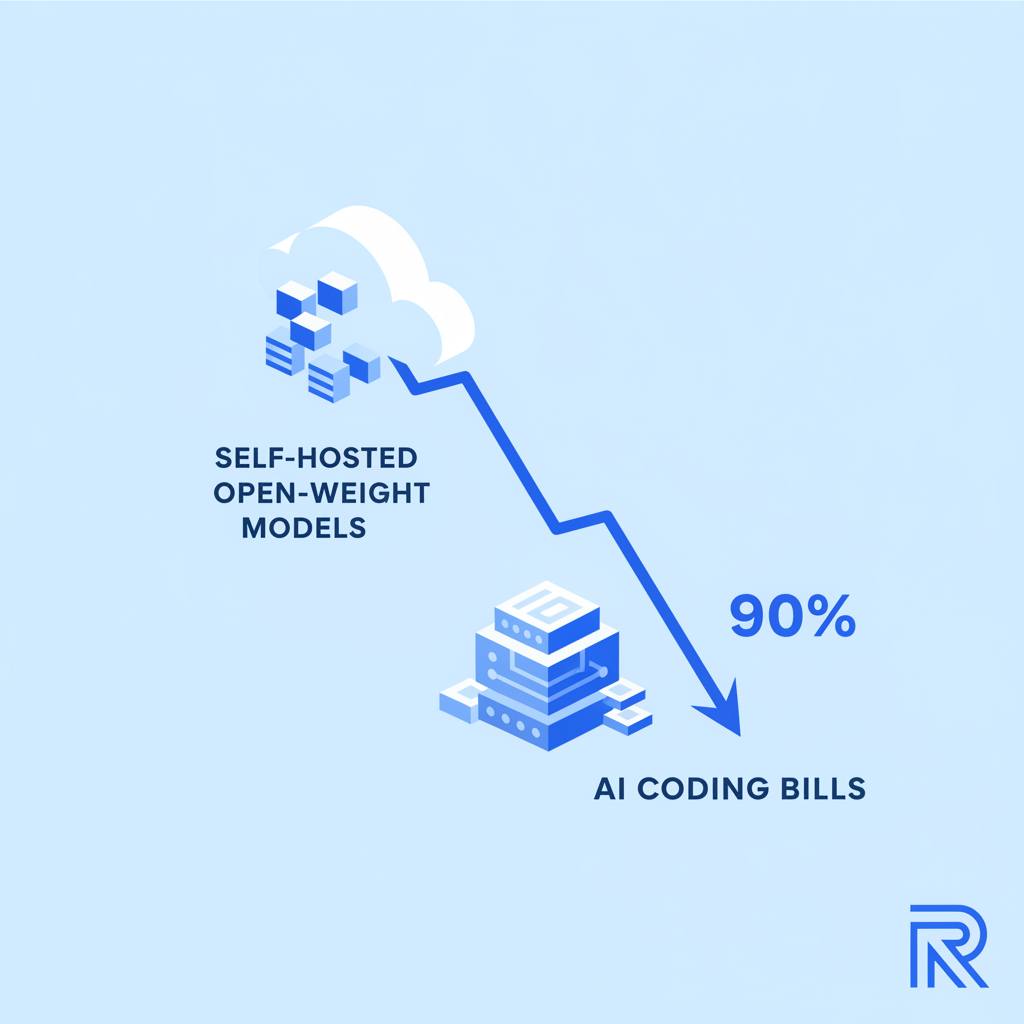
Fintech giant Revolut found a smart way to cut its AI coding costs by 90%. Instead of expensive frontier models, they moved to self-hosting open-weight AI, which also made coding faster.
Imagine paying huge bills for something that isn't giving you the return you hoped for. That's exactly what British fintech company Revolut faced with its AI coding assistants. Their bills exploded, with some engineers spending up to $10,000 a month on 'AI tokens' with little measurable return. But Revolut found an innovative solution, and this holds important lessons for all companies using AI: significant savings and speed can be achieved in unconventional ways.
Revolut's journey began in early 2025 with Gemini, then Claude Code in early 2026, but costs spun out of control while the actual impact was modest. So, what did they do? In April 2026, they took a bold step: they ditched expensive frontier APIs as their default and started self-hosting open-weight AI models. They began with GLM-5.1 from Chinese lab Z.ai, then upgraded to GLM-5.3, which now runs on about 56 Nvidia B200 GPUs.
The results were astonishing: a 90% cut in AI coding inference costs, meaning massive savings. It wasn't just about saving money; coding speed improved by 60%, and lead time (from pickup to merge) improved by 70% for their 2,000 engineers. They even saw a 76% increase in requests per second after tuning, and an 88% reduction in time-to-first-token (from 14.3 seconds to 1.7 seconds).
What's even more interesting is that older models like Claude Code and OpenAI's Codex haven't completely vanished; they've become an 'exception list,' used only when the self-hosted setup can't do the job, especially for UI work and the hardest problems since GLM is text-only. The most important lesson here, as Revolut states, is that «cheap unlimited tokens, not smarter AI, is what speeds up coding». This opens up new possibilities for companies to cut costs and boost productivity without sacrificing quality.
Revolut's journey began in early 2025 with Gemini, then Claude Code in early 2026, but costs spun out of control while the actual impact was modest. So, what did they do? In April 2026, they took a bold step: they ditched expensive frontier APIs as their default and started self-hosting open-weight AI models. They began with GLM-5.1 from Chinese lab Z.ai, then upgraded to GLM-5.3, which now runs on about 56 Nvidia B200 GPUs.
The results were astonishing: a 90% cut in AI coding inference costs, meaning massive savings. It wasn't just about saving money; coding speed improved by 60%, and lead time (from pickup to merge) improved by 70% for their 2,000 engineers. They even saw a 76% increase in requests per second after tuning, and an 88% reduction in time-to-first-token (from 14.3 seconds to 1.7 seconds).
What's even more interesting is that older models like Claude Code and OpenAI's Codex haven't completely vanished; they've become an 'exception list,' used only when the self-hosted setup can't do the job, especially for UI work and the hardest problems since GLM is text-only. The most important lesson here, as Revolut states, is that «cheap unlimited tokens, not smarter AI, is what speeds up coding». This opens up new possibilities for companies to cut costs and boost productivity without sacrificing quality.