Modern businesses struggle with data scattered across many systems, making it hard to use for AI. A Data Fabric on AWS offers an architecture to connect these sources, improving data discovery, governance, and powering advanced analytics.
Do you find your company’s data scattered everywhere, making it hard to fully use? This is a very common problem today. Modern organizations store huge amounts of information across different databases, multiple applications, data lakes, and separate streaming platforms. The real challenge is making all that data discoverable, secure, and useful without having to build custom integration solutions for every single team.
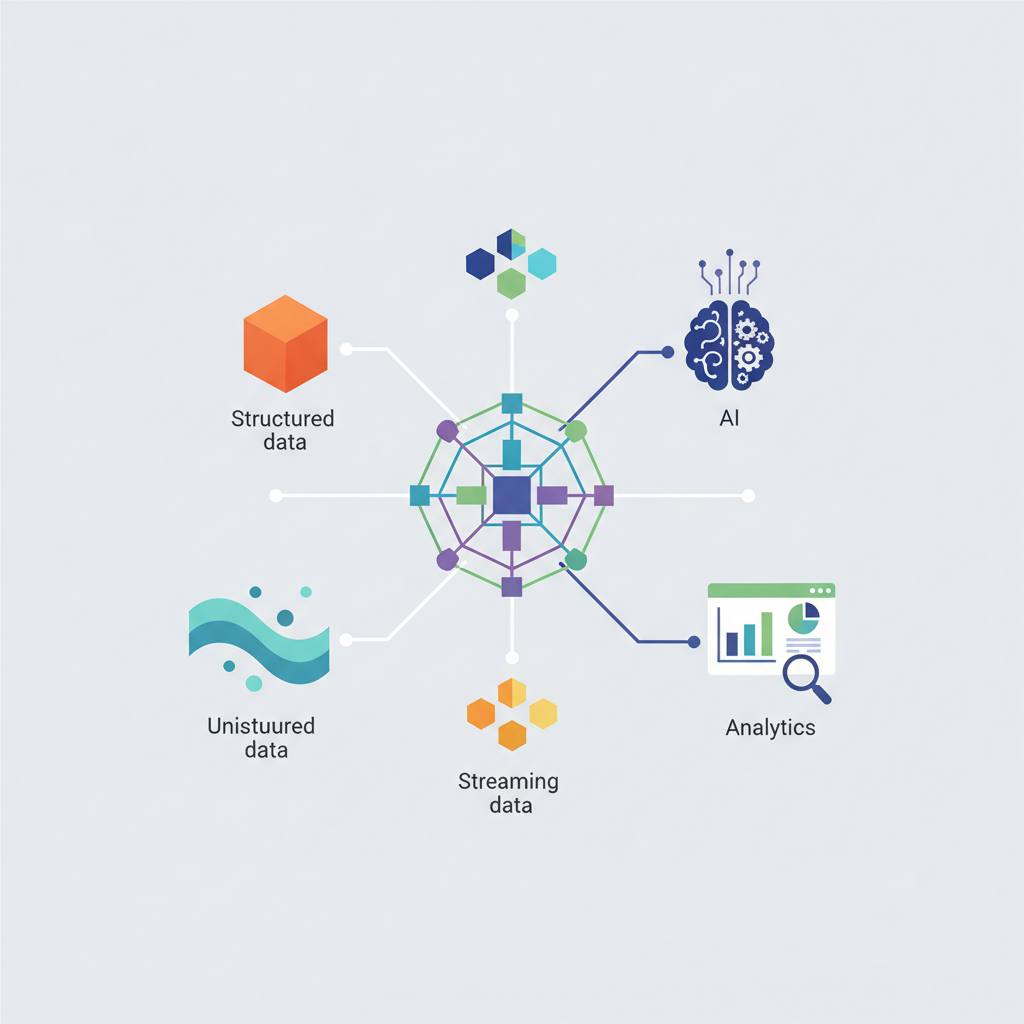
This is where a «Data Fabric» on AWS comes in. Simply put, it's an architectural approach to connecting all your data sources together. What does this mean for you? It means you won't have to create individual solutions to link your data every time you want to use it. Instead, this architecture provides an organized way to connect everything, from traditional databases to large storage files and constantly arriving data.
Consider an e-commerce company. Customer records might be in one database, order history in other storage files, and website browsing events arriving in real-time. Without a coordinated approach, different teams might duplicate datasets, define metrics differently, and manage permissions inconsistently. This wastes time and causes confusion.
A Data Fabric isn't a single AWS service that automatically does everything. Instead, it's an architecture you design and configure using a combination of existing AWS services. For example, you can use Amazon S3 to store your data, AWS Glue to discover and transform it, AWS Lake Formation to manage permissions, and Amazon Athena to query data using SQL. You can even use Amazon Bedrock to build generative AI applications that use your approved business information.
The goal is to improve data discovery, reduce the need for repeated integration work, and establish more consistent governance. This allows you to run better analytics and powerful AI applications based on unified and secure data. Ultimately, it means greater efficiency and a faster ability to make smart decisions.