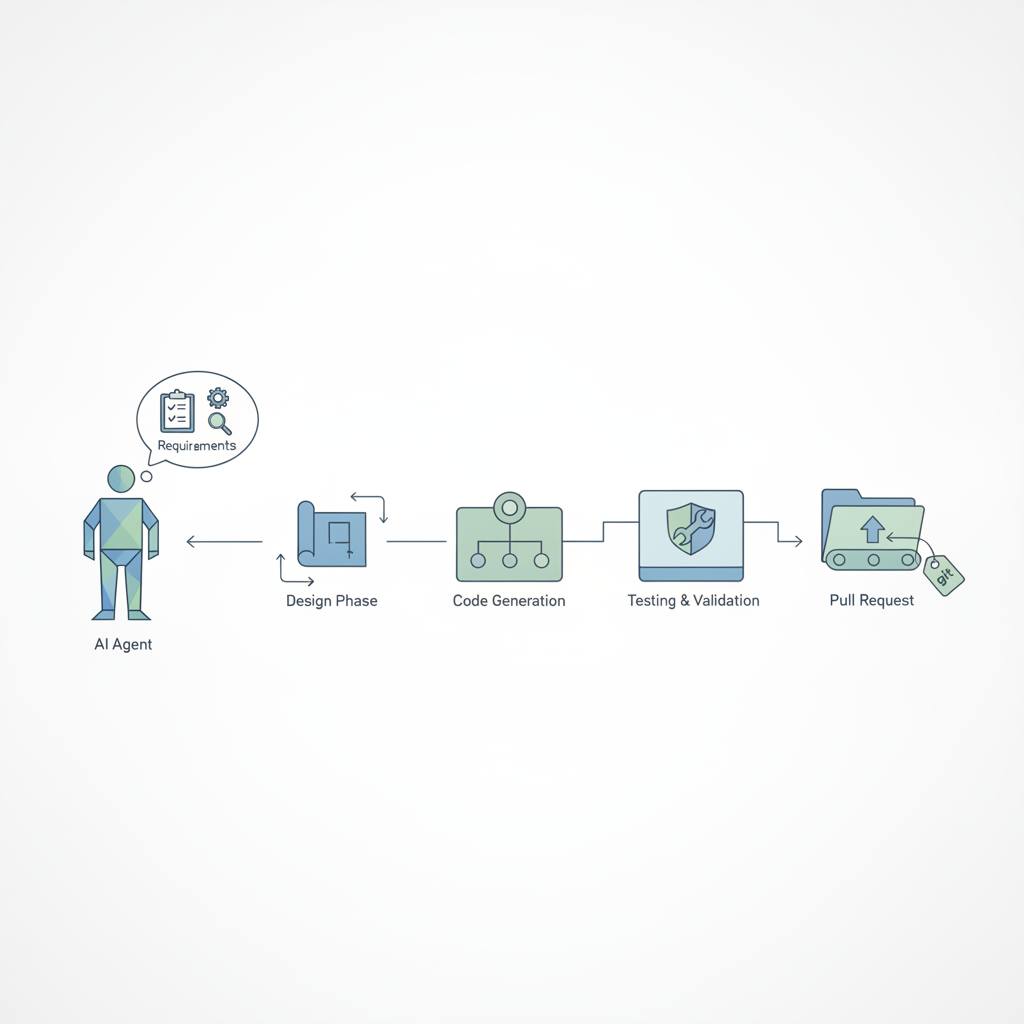
A new technique demonstrates how AI agents can assist in building Continuous Integration (CI) pipelines, emphasizing that each step is documented and requires human approval. It starts by defining clear, measurable requirements to effectively guide the AI.
In the world of software development, we're seeing an innovative way to use AI agents to build Continuous Integration (CI) pipelines more intelligently and efficiently. For you, the developer, this means a more organized development process where every decision is documented step-by-step, with crucial human review points.
The key isn't full automation, but creating a system where every stage is clear and accountable. Everything starts with requirements, and these must be well-written, not just spoken during meetings. The preferred method is using a 'GitHub Issue' for each task, divided into three parts: the problem, the desired behavior, and the success criteria. This last part – measurable success criteria – is the most important, as it becomes the clear target for the AI agent and the basis for final tests.
This is where a tool like 'spec-kit' comes in. After installation, commands like 'speckit-specify' can be used to create a feature-specific folder and a 'spec.md' file. This file enforces the writing of three main points: user scenarios with their priorities, requirements, and measurable success criteria. Forcing us to think 'what does done look like?' prevents the AI agent from guessing what you want and ensures the results precisely meet your expectations.
After requirements are defined, 'speckit-tasks' converts them into a list of small, ordered tasks based on their dependencies. Each task should be small enough for the AI agent to complete in one round and include its own acceptance criteria. If a task is too large, it must be broken down first. This is a crucial point many teams misunderstand: AI agents cannot tackle large tasks all at once; the bigger the task, the more likely errors will occur. At this stage, agents like 'OpenHands' or 'Claude Code' come into play to execute these precisely defined tasks. This method ensures the workflow proceeds smoothly and efficiently with human intervention when necessary.