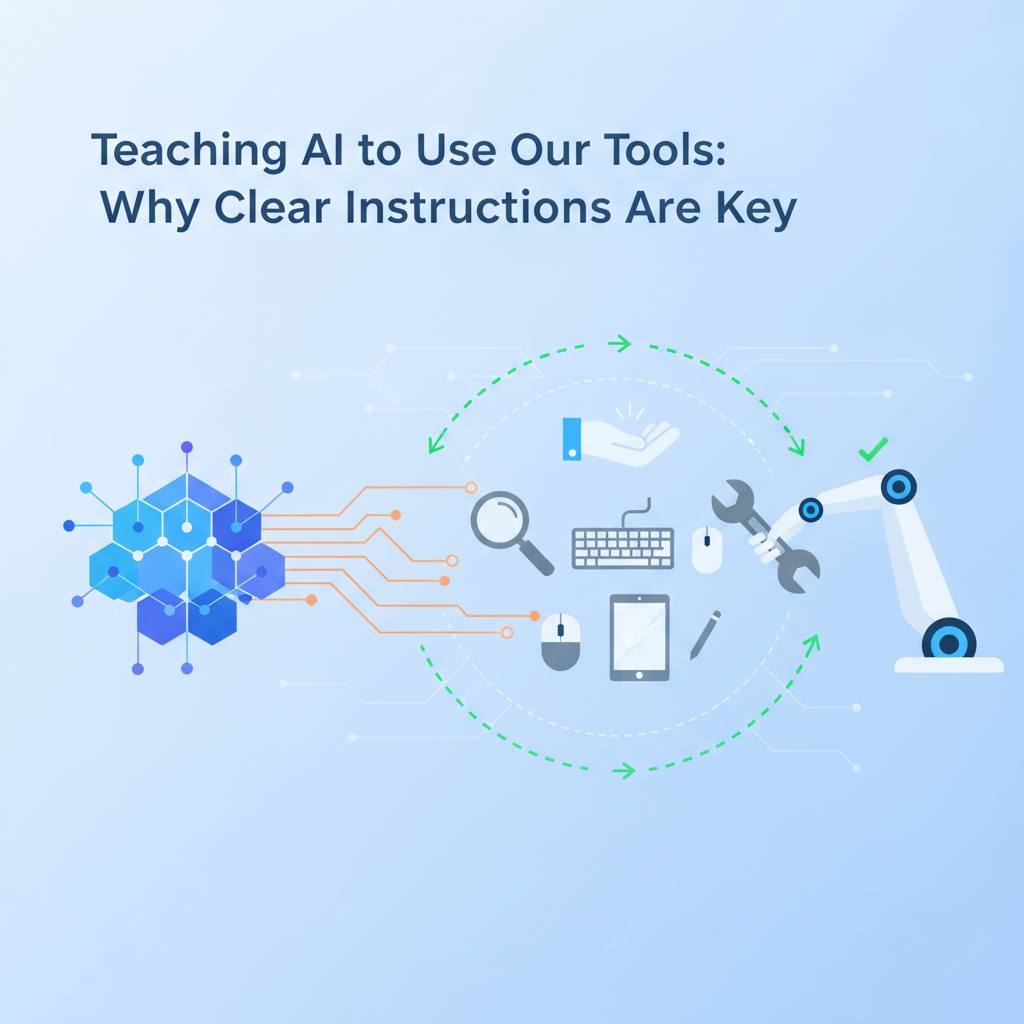
As AI models increasingly use our software tools directly, it's become crucial to write clear and precise instructions (called 'contracts') for them. This ensures AI interprets commands correctly and acts responsibly, unlike human developers who can ask for clarification.
Welcome to the exciting world of AI! Have you ever imagined artificial intelligence programs using our digital tools all by themselves? This isn't science fiction; it's happening today. The news we read highlights how your server's 'client' is now a language model – in other words, AI is directly interacting with our internal software and tools.
Let's use an analogy. Imagine you have a robot assistant in your kitchen. If you give it a recipe, it will follow it very precisely. If you say, 'add some salt,' it might add too much or too little because it lacks human judgment or the ability to ask you 'how much exactly?' But if you say, 'add one teaspoon of salt,' it understands exactly what to do.
This is precisely what's happening now in the world of programming. When a human developer integrates a new program, they read the instructions, test things out, and ask questions if something is unclear. But when your program's 'client' is an AI language model, it doesn't do any of that. It reads the tool's description and instructions once, then makes a decision and acts immediately, potentially hundreds of times an hour.
This means that ambiguity in your program's instructions can be incredibly costly. If the instructions aren't clear, the AI will act based on its 'best guess,' which can lead to undesirable outcomes or repeated errors. While a human developer might catch ambiguities during development, an AI agent might discover them in production – leading to real, expensive problems.
The solution is a 'contract.' Here, a contract means a set of very clear, specific, and unambiguous instructions. It must precisely describe the tool's function and how it should behave in every situation, even when errors occur. Here are some examples of what makes a good 'contract' for AI:
1. **Clear Description**: Instead of 'Manage Users,' say 'Add a new user with name and email, or update an existing user's information by ID.' The tool's purpose and description must be unambiguous.
2. **Specific Errors**: If there's an error, the system should say 'Invalid email address' instead of just 'Error.' This allows the AI to self-correct and try something else.
3. **Destructive Actions**: Actions that could cause significant harm (like 'delete data') must be clearly flagged in the contract, perhaps requiring additional confirmation before execution.
4. **Idempotency**: The tool should be designed so that if the AI accidentally tries to execute the same command twice (e.g., due to a network glitch), it only happens once (like a money transfer operation or sending a welcome email).
Ultimately, writing these clear 'contracts' is like learning a new language to communicate with AI. They aren't just documents; they are the way we ensure our tools operate reliably and safely when managed by artificial intelligence. This principle is fundamental to building robust and effective AI systems in the future.
Let's use an analogy. Imagine you have a robot assistant in your kitchen. If you give it a recipe, it will follow it very precisely. If you say, 'add some salt,' it might add too much or too little because it lacks human judgment or the ability to ask you 'how much exactly?' But if you say, 'add one teaspoon of salt,' it understands exactly what to do.
This is precisely what's happening now in the world of programming. When a human developer integrates a new program, they read the instructions, test things out, and ask questions if something is unclear. But when your program's 'client' is an AI language model, it doesn't do any of that. It reads the tool's description and instructions once, then makes a decision and acts immediately, potentially hundreds of times an hour.
This means that ambiguity in your program's instructions can be incredibly costly. If the instructions aren't clear, the AI will act based on its 'best guess,' which can lead to undesirable outcomes or repeated errors. While a human developer might catch ambiguities during development, an AI agent might discover them in production – leading to real, expensive problems.
The solution is a 'contract.' Here, a contract means a set of very clear, specific, and unambiguous instructions. It must precisely describe the tool's function and how it should behave in every situation, even when errors occur. Here are some examples of what makes a good 'contract' for AI:
1. **Clear Description**: Instead of 'Manage Users,' say 'Add a new user with name and email, or update an existing user's information by ID.' The tool's purpose and description must be unambiguous.
2. **Specific Errors**: If there's an error, the system should say 'Invalid email address' instead of just 'Error.' This allows the AI to self-correct and try something else.
3. **Destructive Actions**: Actions that could cause significant harm (like 'delete data') must be clearly flagged in the contract, perhaps requiring additional confirmation before execution.
4. **Idempotency**: The tool should be designed so that if the AI accidentally tries to execute the same command twice (e.g., due to a network glitch), it only happens once (like a money transfer operation or sending a welcome email).
Ultimately, writing these clear 'contracts' is like learning a new language to communicate with AI. They aren't just documents; they are the way we ensure our tools operate reliably and safely when managed by artificial intelligence. This principle is fundamental to building robust and effective AI systems in the future.