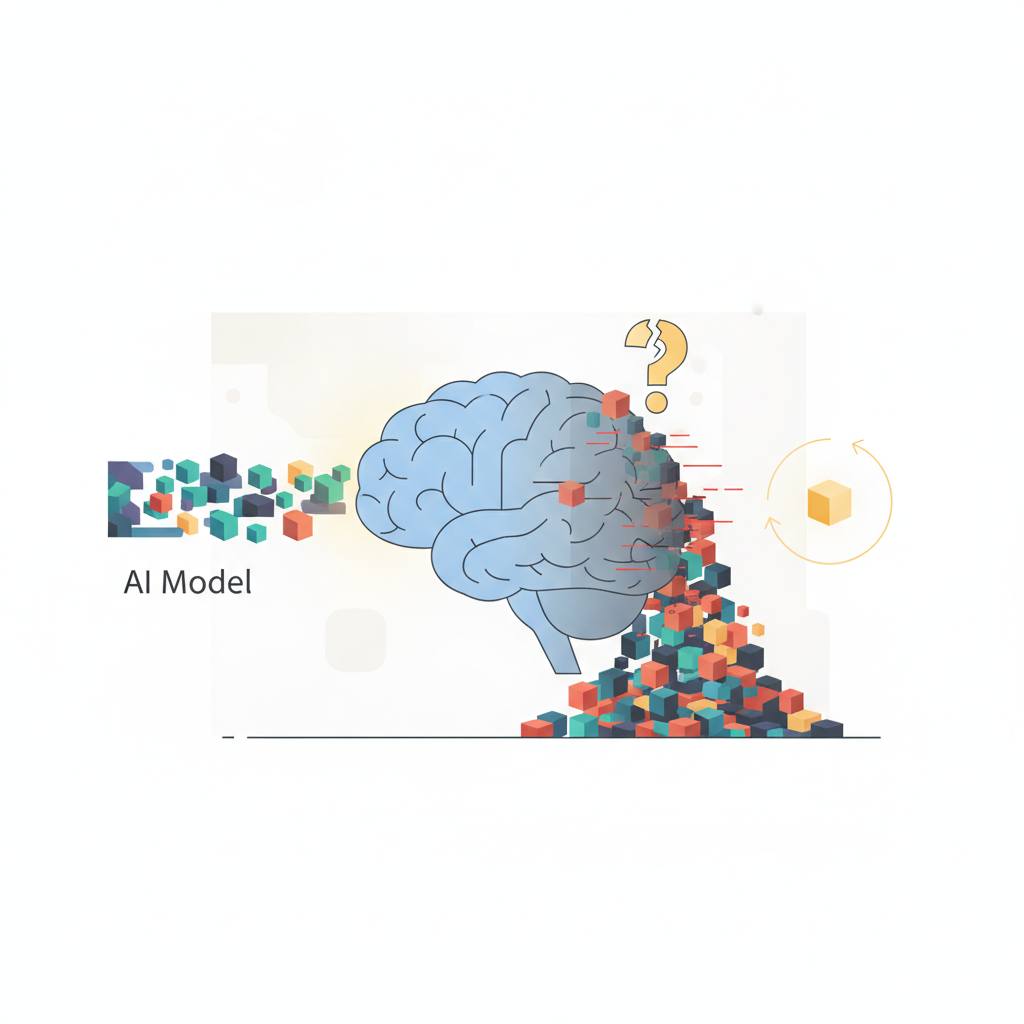
Recent studies show that feeding AI models longer texts actually makes them perform worse at their tasks, leading to what's now called «context rot». This means increasing the input context doesn't improve performance; it can significantly reduce it.
Here's a surprising piece of news from the world of AI: giving AI models *more* information actually makes them perform *worse*! That's right, instead of getting smarter with longer texts, they get worse. What does this mean for you? Simply put, your super-long prompts to AI might be hurting its accuracy.
For a while, we've all thought bigger input context windows meant better performance, but recent research proves the opposite. This effect even has a name now: «context rot». Think about it: if you had to brief a sharp new colleague on a problem, would you hand them one page with the three critical facts, or 400 pages of meeting minutes with those same facts buried inside? You'd pick the one page, of course. Yet, we do the latter with AI models every day.
In July 2025, researchers Kelly Hong, Anton Troynikov, and Jeff Huber at Chroma published a significant technical report. They studied 18 models from major players like Anthropic, OpenAI, Google, and Alibaba, including Claude Opus 4, GPT-4.1, Gemini 2.5 Pro, and Qwen3. Their approach was straightforward: keep the task the same, make the input longer, and watch what happened.
One of the clearest tests used the LongMemEval benchmark. Each model answered questions about a long chat history twice. Once with the full history (about 113,000 tokens), and once with only the relevant excerpt (about 300 tokens). The answer was present in both versions. The surprising finding? Every model performed significantly better with the shorter, 300-token version.
What this tells us is that the extra 112,700 tokens in the long prompt didn't add any missing facts; they only added more things for the model to sift through. And that alone was enough to lower the performance score. Even with trivial tasks, like finding a single different word in a repeated list, models struggled as context length increased. So, remember, less might actually be more when it comes to your AI inputs.
For a while, we've all thought bigger input context windows meant better performance, but recent research proves the opposite. This effect even has a name now: «context rot». Think about it: if you had to brief a sharp new colleague on a problem, would you hand them one page with the three critical facts, or 400 pages of meeting minutes with those same facts buried inside? You'd pick the one page, of course. Yet, we do the latter with AI models every day.
In July 2025, researchers Kelly Hong, Anton Troynikov, and Jeff Huber at Chroma published a significant technical report. They studied 18 models from major players like Anthropic, OpenAI, Google, and Alibaba, including Claude Opus 4, GPT-4.1, Gemini 2.5 Pro, and Qwen3. Their approach was straightforward: keep the task the same, make the input longer, and watch what happened.
One of the clearest tests used the LongMemEval benchmark. Each model answered questions about a long chat history twice. Once with the full history (about 113,000 tokens), and once with only the relevant excerpt (about 300 tokens). The answer was present in both versions. The surprising finding? Every model performed significantly better with the shorter, 300-token version.
What this tells us is that the extra 112,700 tokens in the long prompt didn't add any missing facts; they only added more things for the model to sift through. And that alone was enough to lower the performance score. Even with trivial tasks, like finding a single different word in a repeated list, models struggled as context length increased. So, remember, less might actually be more when it comes to your AI inputs.