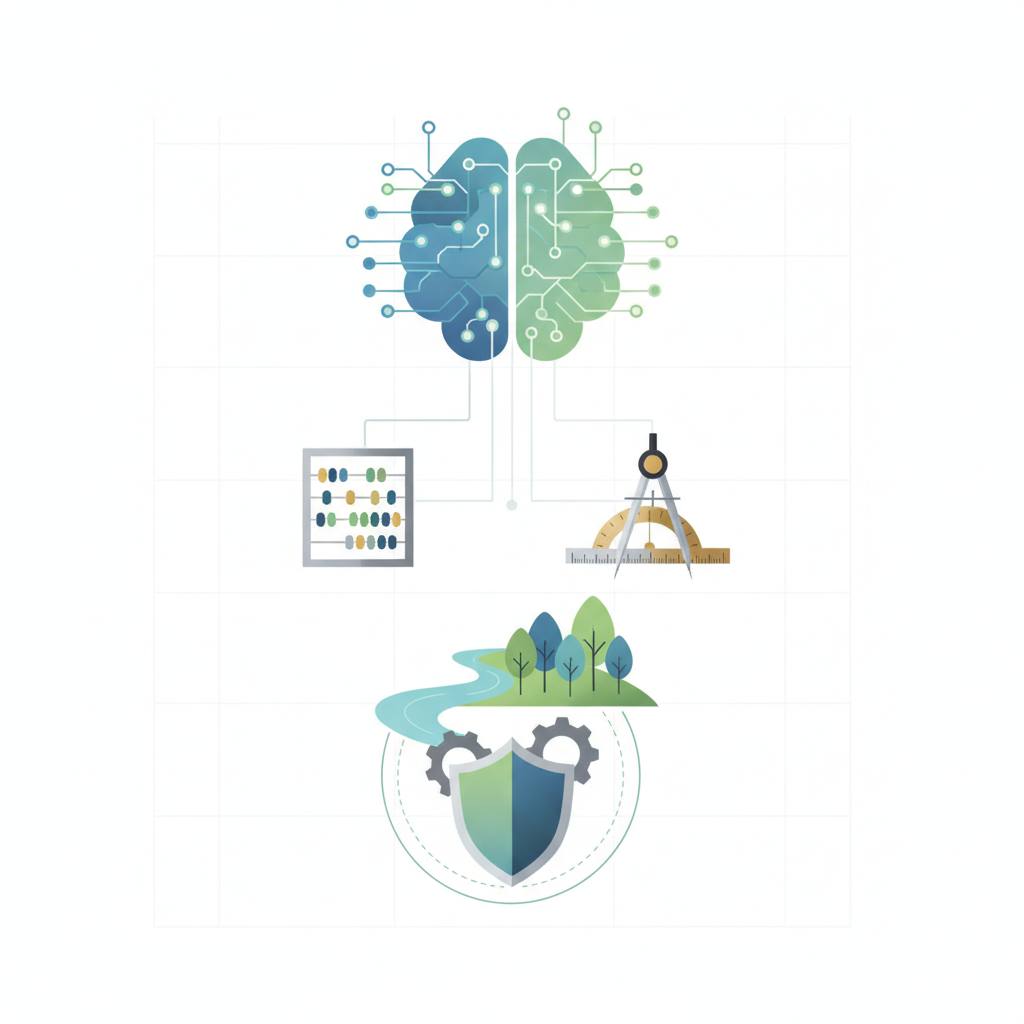
New digital tools are helping AI tackle the complex, precise math required for industrial environmental compliance, especially for air emission testing. This means AI can now confidently handle strict regulations, avoiding costly errors.
Ever wondered how AI could help keep our environment clean, especially with strict factory emission rules? Well, there's an exciting development bridging AI with the very precise math needed for environmental compliance, promising a big improvement in how things get done.
The big issue has been that smart systems like Large Language Models (LLMs) are great at understanding and responding to text, but they stumble when it comes to the rigid, exact mathematical calculations required by environmental protection rules. Imagine asking an AI to calculate complex traverse points or sampling heights for factory emission tests; a single tiny error could invalidate the entire test. This leads to massive re-testing costs for companies, not to mention potential legal problems. That's because these models are built on probabilities and 'guessing,' while these calculations demand absolute precision and certainty.
The good news is that developers have found a way to bridge this gap. Instead of trying to make AI 'guess' the numbers, they're now using specialized 'Logic Connectors.' These aren't just chatbot programs; they're tools designed to solve specific physics problems with exactness. For instance, there's a tool called the 'Stack Testing Protocol Designer.' On its own, it might look like a calculator for environmental engineers. But in reality, it allows AI to access the mathematical logic needed to perform complex calculations with extreme precision.
Take 'isokinetic sampling' as an example – a crucial method for accurately measuring air emissions. This method requires the gas velocity entering the sampling nozzle to precisely match the gas velocity inside the stack. If that ratio deviates significantly, the sample becomes inaccurate. Previously, AI lacked direct access to the geometric constants needed for such calculations. But thanks to these new tools, AI can now use specific functions like: 'get_sampling_strategy' to determine optimal vertical positioning, 'calculate_traverse_points' to precisely figure out how many measurement points are needed across a stack diameter, and 'determine_test_duration'.
What does this mean for us? It means we're moving beyond just using AI for generating text to using it for solving practical, complex, real-world problems. This development not only reduces errors and the hefty costs of re-testing but also helps ensure our environmental data is accurate and reliable. Ultimately, this means better compliance with regulations, cleaner air, and a healthier environment for all of us, thanks to AI that can now 'do the math' the right way.
The big issue has been that smart systems like Large Language Models (LLMs) are great at understanding and responding to text, but they stumble when it comes to the rigid, exact mathematical calculations required by environmental protection rules. Imagine asking an AI to calculate complex traverse points or sampling heights for factory emission tests; a single tiny error could invalidate the entire test. This leads to massive re-testing costs for companies, not to mention potential legal problems. That's because these models are built on probabilities and 'guessing,' while these calculations demand absolute precision and certainty.
The good news is that developers have found a way to bridge this gap. Instead of trying to make AI 'guess' the numbers, they're now using specialized 'Logic Connectors.' These aren't just chatbot programs; they're tools designed to solve specific physics problems with exactness. For instance, there's a tool called the 'Stack Testing Protocol Designer.' On its own, it might look like a calculator for environmental engineers. But in reality, it allows AI to access the mathematical logic needed to perform complex calculations with extreme precision.
Take 'isokinetic sampling' as an example – a crucial method for accurately measuring air emissions. This method requires the gas velocity entering the sampling nozzle to precisely match the gas velocity inside the stack. If that ratio deviates significantly, the sample becomes inaccurate. Previously, AI lacked direct access to the geometric constants needed for such calculations. But thanks to these new tools, AI can now use specific functions like: 'get_sampling_strategy' to determine optimal vertical positioning, 'calculate_traverse_points' to precisely figure out how many measurement points are needed across a stack diameter, and 'determine_test_duration'.
What does this mean for us? It means we're moving beyond just using AI for generating text to using it for solving practical, complex, real-world problems. This development not only reduces errors and the hefty costs of re-testing but also helps ensure our environmental data is accurate and reliable. Ultimately, this means better compliance with regulations, cleaner air, and a healthier environment for all of us, thanks to AI that can now 'do the math' the right way.