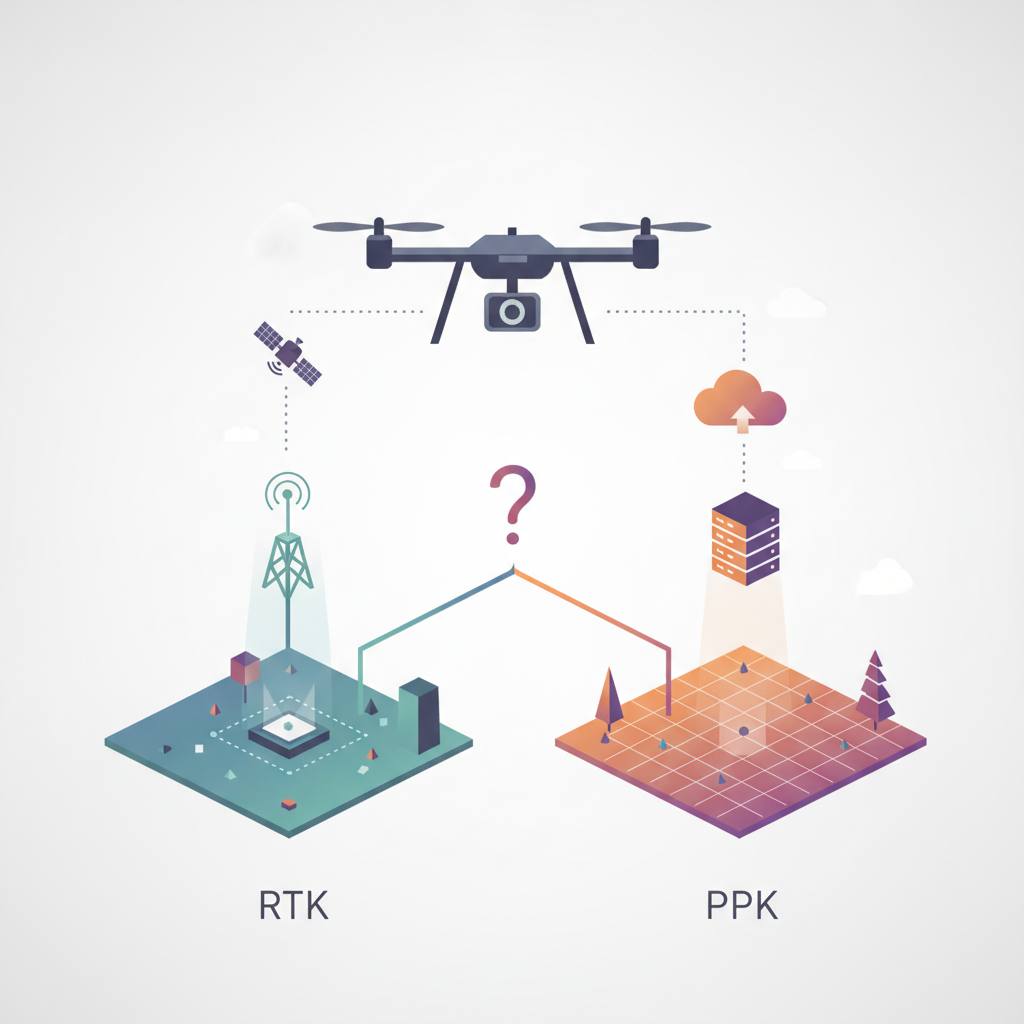
For accurate drone mapping, you'll choose between RTK and PPK. This guide explains their differences and helps you pick the right technology for your flights.
If you fly drones for mapping, surveying, or inspection, you have two main options for achieving super-accurate positioning: RTK (Real-Time Kinematic) and PPK (Post-Processed Kinematic). Understanding the differences between these two is key to getting the best results from your drone operations.
RTK works by applying corrections to your drone's position data *during* the flight. A base station transmits real-time correction data to your drone, often via cellular connection (4G/LTE) or a dedicated radio. This allows the drone's GNSS receiver to calculate its position with centimeter accuracy right then and there. The big advantage of RTK is immediate feedback: the pilot knows if the accuracy is good («RTK Fixed») while flying, and the geotagged images are ready for processing straight after landing. This also means you can quickly spot if something goes wrong, like the correction link dropping, and adjust your flight plan on the spot.
However, RTK relies heavily on a continuous, stable connection to that correction link. If you lose cellular signal in remote or hilly areas, or at low altitude, or fly too far from your radio base, you'll lose your RTK accuracy. The problem is, if this link drops even for a short time during a critical part of your flight, that data may be less accurate, and there's no way to fix it later. Plus, using cellular data for NTRIP corrections can mean extra costs and depends on having good network coverage.
This is where PPK comes in as a fantastic alternative or safety net. While RTK applies corrections in real-time, PPK allows you to recover accuracy *after* the flight. This is especially useful in challenging environments like hilly terrain, urban canyons, or when flying long distances where a real-time link might struggle. If your correction link drops during the flight, PPK can still help you achieve centimeter accuracy by processing the data later. Many professional mapping teams actually use both: RTK gives the pilot live accuracy feedback, while simultaneously logging raw data for PPK as a dependable backup, ensuring maximum data quality regardless of real-time link stability.
So, when making your choice, think about your flight environment. Need real-time precision and a reliable connection? RTK is great. Expect connection drops or want a robust safety net? PPK has your back, and often, combining both is the smart move for the highest confidence in your data.
RTK works by applying corrections to your drone's position data *during* the flight. A base station transmits real-time correction data to your drone, often via cellular connection (4G/LTE) or a dedicated radio. This allows the drone's GNSS receiver to calculate its position with centimeter accuracy right then and there. The big advantage of RTK is immediate feedback: the pilot knows if the accuracy is good («RTK Fixed») while flying, and the geotagged images are ready for processing straight after landing. This also means you can quickly spot if something goes wrong, like the correction link dropping, and adjust your flight plan on the spot.
However, RTK relies heavily on a continuous, stable connection to that correction link. If you lose cellular signal in remote or hilly areas, or at low altitude, or fly too far from your radio base, you'll lose your RTK accuracy. The problem is, if this link drops even for a short time during a critical part of your flight, that data may be less accurate, and there's no way to fix it later. Plus, using cellular data for NTRIP corrections can mean extra costs and depends on having good network coverage.
This is where PPK comes in as a fantastic alternative or safety net. While RTK applies corrections in real-time, PPK allows you to recover accuracy *after* the flight. This is especially useful in challenging environments like hilly terrain, urban canyons, or when flying long distances where a real-time link might struggle. If your correction link drops during the flight, PPK can still help you achieve centimeter accuracy by processing the data later. Many professional mapping teams actually use both: RTK gives the pilot live accuracy feedback, while simultaneously logging raw data for PPK as a dependable backup, ensuring maximum data quality regardless of real-time link stability.
So, when making your choice, think about your flight environment. Need real-time precision and a reliable connection? RTK is great. Expect connection drops or want a robust safety net? PPK has your back, and often, combining both is the smart move for the highest confidence in your data.