This post uncovers the crucial security reason why AI agents purposefully return zero memories for new vendors during invoice processing, a vital feature for preventing fraud. This 'forgetting' isn't a flaw; it's a key design choice to ensure transaction integrity.
In the tech world, 'memory' is often seen as a valuable feature, but for AI systems managing invoice payments, 'forgetting' can be its greatest defense! Imagine you have an AI system handling your company's invoices; its job is to ensure the right invoices are paid, at the right time, to the right entity. But when an invoice arrives from a vendor your company has never paid before, this system completely bypasses any past memory and returns an empty list. Sounds like a bug, right? In reality, it's a critically important security feature that protects you from fraud.
What does this mean for you and your company? It means that smart payment systems like «LedgerMind» are designed with incredible wisdom. Instead of trying to guess or link a new vendor's information to other 'similar' vendors, it completely ignores any memory. This protects your company from being tricked by invoice fraudsters who might try to impersonate trusted vendors or create fake ones.
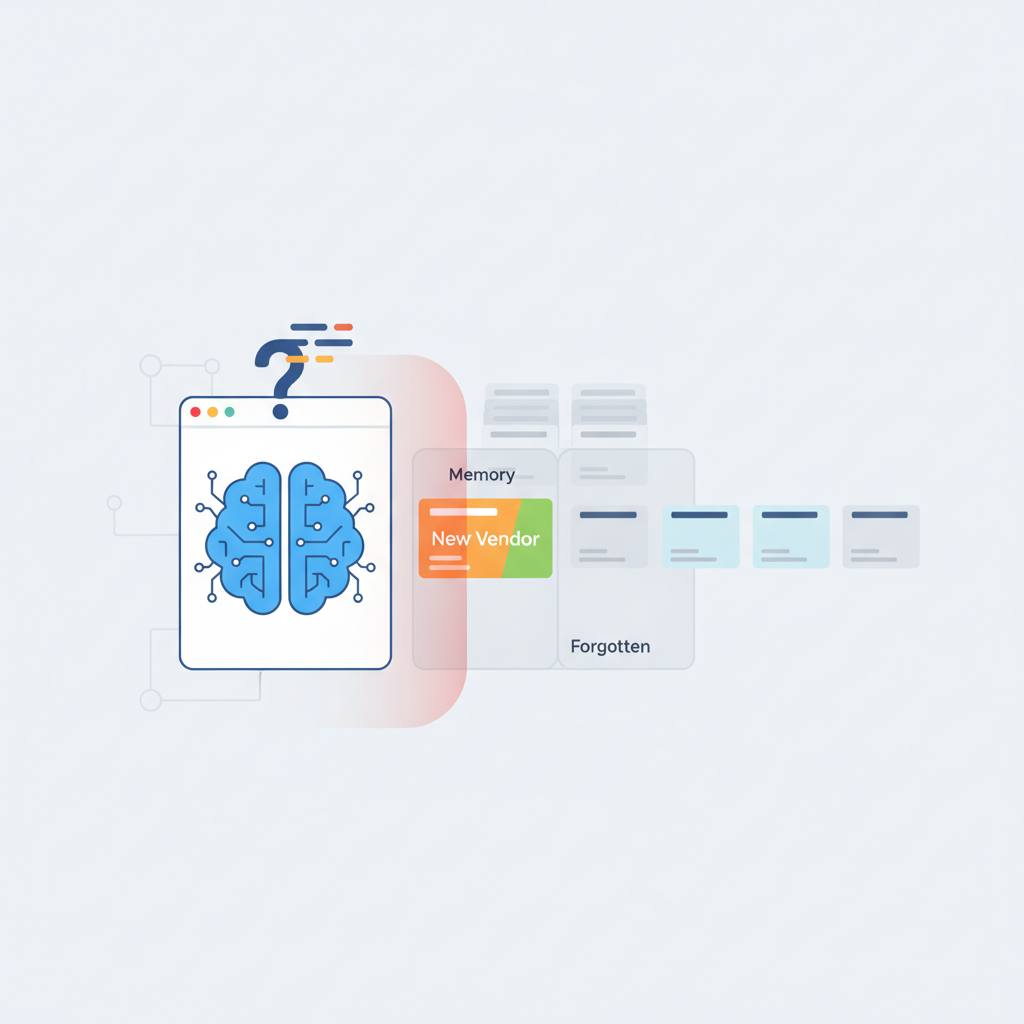
How does this work? When an invoice goes through the payment system, it passes through steps like verifying the purchase order, goods receipt, and then 'memory recall'. Here's the crucial point: if no previous invoice has been paid to this specific vendor, the system simply 'refuses' to recall any memory. Imagine asking a bank about a vendor it has never heard of; if the bank tried to 'helpfully' provide information about 'similar' vendors – perhaps in the same category or with similar terms – this could be very dangerous. A brand-new supplier could inherit a good reputation they don't deserve, opening the door to fraud attempts, especially those targeting bank account details.
This is why intelligent systems like «Hindsight», which provides memory for payment agents, must be tightly constrained. The 'recallVendorMemory' function is specifically designed not to 'ask' for any memory if the vendor master record shows we've never dealt with this supplier before. This means no misleading 'helpful' links, and no manufactured trust. Trust, in the world of payments, must come from a specific and clear history with the vendor itself. This approach ensures that every payment decision is based on verifiable, specific facts, keeping your company's money safe.
What does this mean for you and your company? It means that smart payment systems like «LedgerMind» are designed with incredible wisdom. Instead of trying to guess or link a new vendor's information to other 'similar' vendors, it completely ignores any memory. This protects your company from being tricked by invoice fraudsters who might try to impersonate trusted vendors or create fake ones.
How does this work? When an invoice goes through the payment system, it passes through steps like verifying the purchase order, goods receipt, and then 'memory recall'. Here's the crucial point: if no previous invoice has been paid to this specific vendor, the system simply 'refuses' to recall any memory. Imagine asking a bank about a vendor it has never heard of; if the bank tried to 'helpfully' provide information about 'similar' vendors – perhaps in the same category or with similar terms – this could be very dangerous. A brand-new supplier could inherit a good reputation they don't deserve, opening the door to fraud attempts, especially those targeting bank account details.
This is why intelligent systems like «Hindsight», which provides memory for payment agents, must be tightly constrained. The 'recallVendorMemory' function is specifically designed not to 'ask' for any memory if the vendor master record shows we've never dealt with this supplier before. This means no misleading 'helpful' links, and no manufactured trust. Trust, in the world of payments, must come from a specific and clear history with the vendor itself. This approach ensures that every payment decision is based on verifiable, specific facts, keeping your company's money safe.