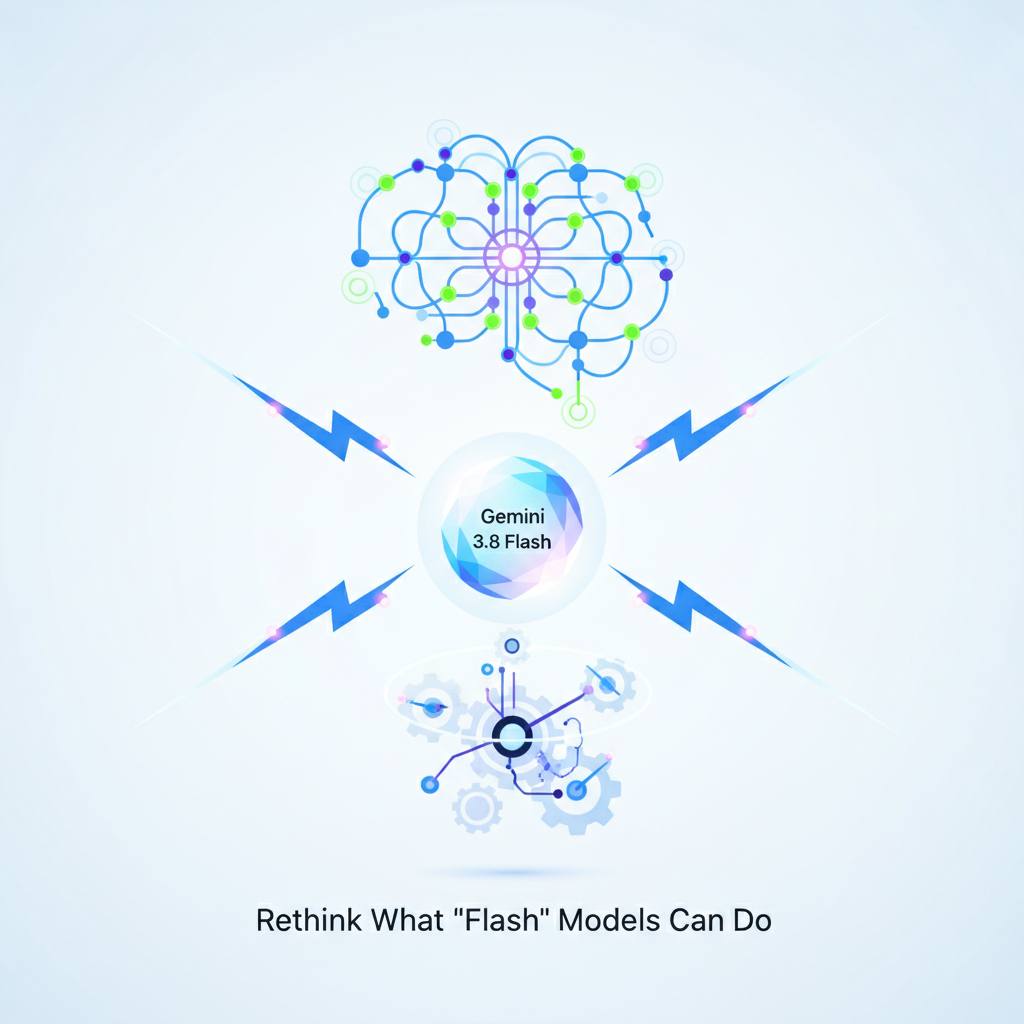
Gemini 3.8 Flash isn't just another update; it significantly boosts Flash models' ability to persist through complex, challenging tasks and recover from errors, making it highly effective for longer, intricate workflows.
Hey WondTech readers! Google is changing how we think about 'Flash' models with the new Gemini 3.8 Flash. This release isn't just about higher numbers; it's a fundamental improvement that will alter how you use it for complex tasks.
Contrary to what you might expect, this version doesn't bring a dramatically larger context window or suddenly become a different class of model. The context window remains roughly the same, around 1 million input tokens and 65,000 output tokens. So, if you're considering upgrading purely because the model number is higher, that might not be a strong enough reason. The crucial part here is the model's enhanced ability to stick with difficult tasks for longer, call tools more persistently, and recover better when the first attempt doesn't work. Imagine a coding agent working through a real repository: it might need to inspect several files, make an edit, run tests, discover something broke, read the error, change its approach, and try again. A weaker agent might look good for the first few steps but quietly fall apart once the workflow gets messy. Gemini 3.8 Flash is clearly aimed more at that second, more challenging half of the task.
Google reports a meaningful jump in performance, scoring 73.7% on DeepSWE v1.1, compared with 65.3% for Gemini 3.7 Flash. This improvement suggests that the 'Flash' tier is becoming much more capable at completing longer coding workflows, rather than just producing good first-pass answers. This fundamentally changes our perception of Flash models. We instinctively associate them with cheap, fast requests like classification, extraction, simple summaries, and high-volume API traffic. However, Gemini 3.8 Flash makes that mental model far less useful. It can take text, images, video, audio, and PDFs as input, while also working with tools such as function calling, code execution, search, and structured data.
In short, if your tasks demand more resilient and persistent agents for tackling complex problems, Gemini 3.8 Flash is definitely worth considering. It's redefining what you can expect from Flash models.
Contrary to what you might expect, this version doesn't bring a dramatically larger context window or suddenly become a different class of model. The context window remains roughly the same, around 1 million input tokens and 65,000 output tokens. So, if you're considering upgrading purely because the model number is higher, that might not be a strong enough reason. The crucial part here is the model's enhanced ability to stick with difficult tasks for longer, call tools more persistently, and recover better when the first attempt doesn't work. Imagine a coding agent working through a real repository: it might need to inspect several files, make an edit, run tests, discover something broke, read the error, change its approach, and try again. A weaker agent might look good for the first few steps but quietly fall apart once the workflow gets messy. Gemini 3.8 Flash is clearly aimed more at that second, more challenging half of the task.
Google reports a meaningful jump in performance, scoring 73.7% on DeepSWE v1.1, compared with 65.3% for Gemini 3.7 Flash. This improvement suggests that the 'Flash' tier is becoming much more capable at completing longer coding workflows, rather than just producing good first-pass answers. This fundamentally changes our perception of Flash models. We instinctively associate them with cheap, fast requests like classification, extraction, simple summaries, and high-volume API traffic. However, Gemini 3.8 Flash makes that mental model far less useful. It can take text, images, video, audio, and PDFs as input, while also working with tools such as function calling, code execution, search, and structured data.
In short, if your tasks demand more resilient and persistent agents for tackling complex problems, Gemini 3.8 Flash is definitely worth considering. It's redefining what you can expect from Flash models.