When the rules of an 'Application Programming Interface' (API) that an AI tool relies on change, the tool might stop working correctly. It's like changing a dish's recipe in a restaurant without updating the menu, leading to customer confusion.
Have you ever used an application or AI tool only to find it suddenly stopped working as it used to? You might see error messages, get unexpected results, or the tool might simply fail entirely. The news we read today about updating MCP tools explains why: it all boils down to software «contracts,» specifically what we call an 'Application Programming Interface' or API.
Imagine you're ordering coffee at a cafe. You tell the barista your order (e.g., 'Latte, light on sugar'). The barista (who here represents the tool you're using) knows exactly how to communicate your request to the coffee machine (which here represents the API). The coffee machine has specific rules for understanding orders (e.g., what constitutes a 'Latte,' and how much is 'light on sugar'). These agreed-upon rules between the barista and the coffee machine are what we call an API «contract.»
Now, what happens if the coffee machine's manufacturer changes how it prepares a 'Latte'? Maybe it renames it to 'Standard Latte,' or now requires you to specify the type of milk every time. If the barista doesn't update their understanding of the machine's requirements or how to phrase orders, your old request won't be understood. The barista will fail to communicate your order correctly, or might even ask you again for clarification.
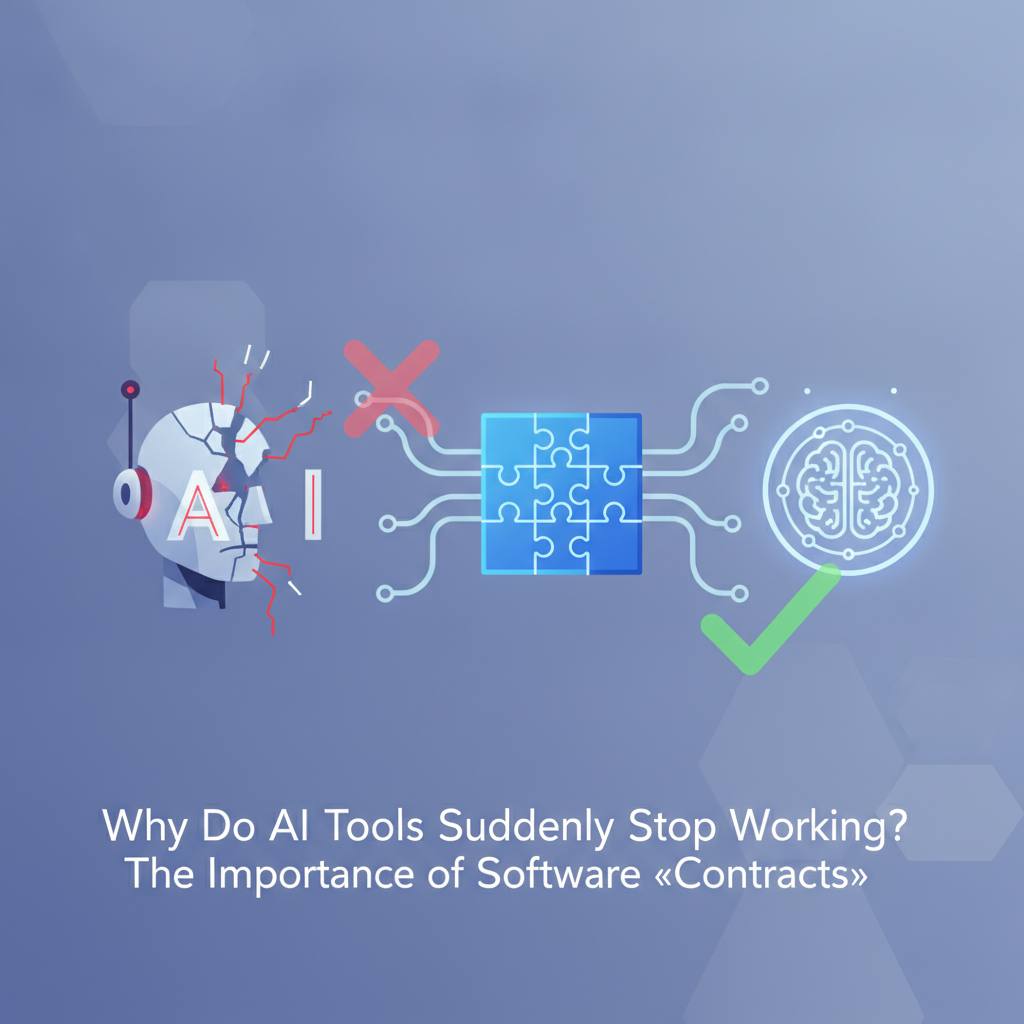
This is precisely what happens with AI tools that rely on APIs. The tool (the barista) expects to speak to the server (the coffee machine) in a specific way, using particular field names and data formats. If API developers change any part of this «contract»—such as renaming a required field, adding a new requirement, or altering the response shape—the old tool won't understand the change and will «break.»
For example, if an API previously expected you to send a customer's «id,» but now expects «customer_id,» an older tool sending «id» will fail. Or, if an AI tool displayed statuses like «open» and «closed,» and the API later added new statuses like «pending» or «resolved,» the tool might not be able to process these new statuses correctly.
Therefore, when APIs change, the tools that depend on them must be updated. This ensures that the «barista» (the tool) always knows how to correctly communicate with the «coffee machine» (the server), so your services and tools continue to operate smoothly without surprises. The goal is to avoid your work being disrupted by a simple change behind the scenes.
Imagine you're ordering coffee at a cafe. You tell the barista your order (e.g., 'Latte, light on sugar'). The barista (who here represents the tool you're using) knows exactly how to communicate your request to the coffee machine (which here represents the API). The coffee machine has specific rules for understanding orders (e.g., what constitutes a 'Latte,' and how much is 'light on sugar'). These agreed-upon rules between the barista and the coffee machine are what we call an API «contract.»
Now, what happens if the coffee machine's manufacturer changes how it prepares a 'Latte'? Maybe it renames it to 'Standard Latte,' or now requires you to specify the type of milk every time. If the barista doesn't update their understanding of the machine's requirements or how to phrase orders, your old request won't be understood. The barista will fail to communicate your order correctly, or might even ask you again for clarification.
This is precisely what happens with AI tools that rely on APIs. The tool (the barista) expects to speak to the server (the coffee machine) in a specific way, using particular field names and data formats. If API developers change any part of this «contract»—such as renaming a required field, adding a new requirement, or altering the response shape—the old tool won't understand the change and will «break.»
For example, if an API previously expected you to send a customer's «id,» but now expects «customer_id,» an older tool sending «id» will fail. Or, if an AI tool displayed statuses like «open» and «closed,» and the API later added new statuses like «pending» or «resolved,» the tool might not be able to process these new statuses correctly.
Therefore, when APIs change, the tools that depend on them must be updated. This ensures that the «barista» (the tool) always knows how to correctly communicate with the «coffee machine» (the server), so your services and tools continue to operate smoothly without surprises. The goal is to avoid your work being disrupted by a simple change behind the scenes.