Ever wondered how JavaScript, despite being single-threaded, manages multiple tasks smoothly? It's all thanks to its clever 'event loop' mechanism, ensuring your code runs without delays.
Have you ever wondered how JavaScript, the programming language powering so much of the web, can handle multiple tasks at once without freezing up? The secret lies in a fascinating mechanism called the 'Event Loop.' Even though JavaScript operates on a 'single thread,' meaning it can only execute one piece of code at a time, the event loop is what gives it its incredible efficiency. This means that web applications built with JavaScript can remain highly responsive, never feeling sluggish or blocked even when complex operations are running behind the scenes.
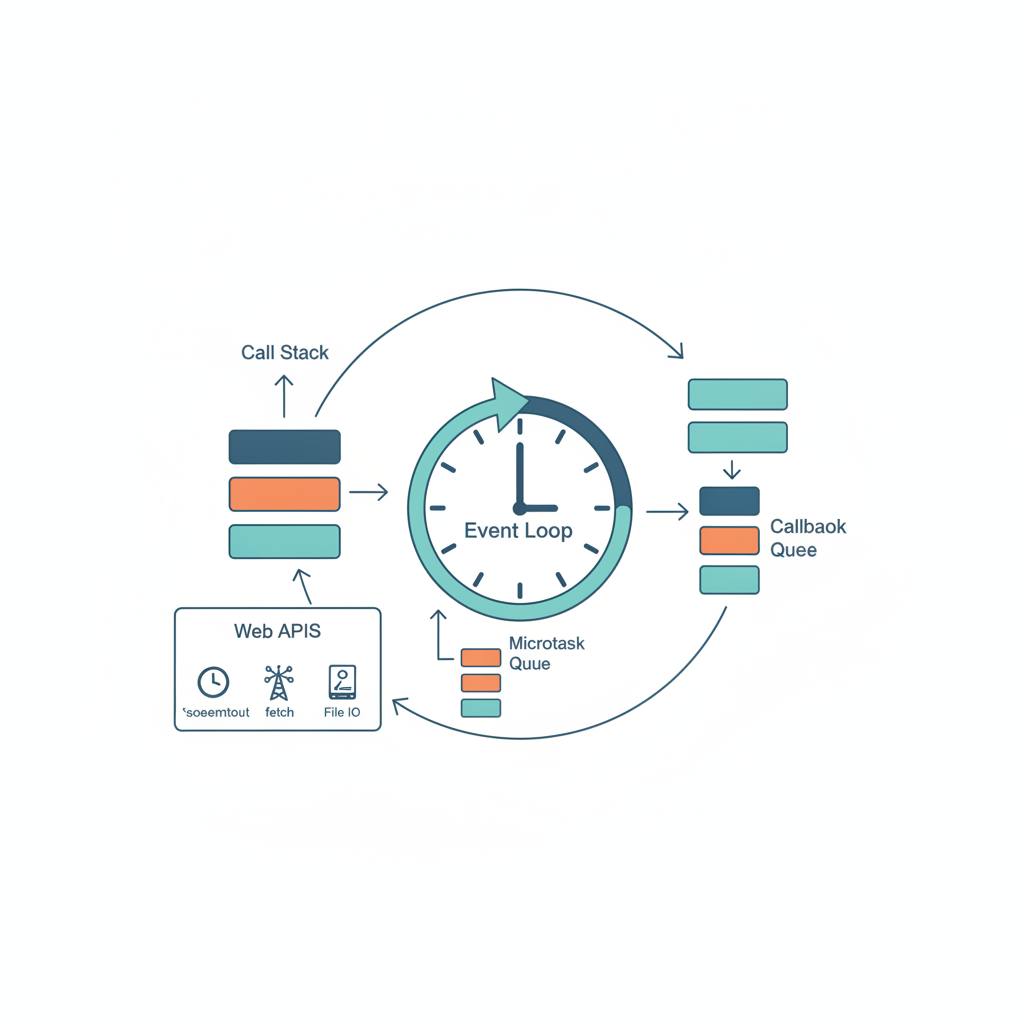
Imagine JavaScript has a few secret helpers. First, there's the 'Call Stack,' which is like a to-do list for immediate tasks JavaScript needs to execute, in the order they come in. When a task finishes, it's popped off the stack. But what about tasks that take time, like fetching data from the internet or countdown timers? That's where 'Web APIs' come in. These are features provided by the browser (or Node.js environment), such as 'setTimeout', DOM events (like a button click), or HTTP requests. These APIs handle their operations independently, away from the main call stack.
Once an asynchronous operation initiated by a Web API completes, its 'callback function' isn't immediately sent back to the call stack. Instead, it's placed into a 'Callback Queue.' However, there's another, higher-priority queue called the 'Microtask Queue,' which holds tasks like Promise callbacks and MutationObservers. These microtasks are processed right after the call stack becomes empty.
This is where the 'Event Loop' steps in. It constantly monitors both the call stack and these queues. When the call stack becomes empty (meaning JavaScript has finished all immediate tasks), the event loop first checks the microtask queue and executes everything in it. After that, if the call stack is still empty, it takes the next callback task from the regular callback queue and pushes it onto the call stack for execution. This cycle repeats endlessly. This clever orchestration ensures that JavaScript can manage complex background tasks without freezing the user interface, providing you with a smooth and fast browsing experience.
Imagine JavaScript has a few secret helpers. First, there's the 'Call Stack,' which is like a to-do list for immediate tasks JavaScript needs to execute, in the order they come in. When a task finishes, it's popped off the stack. But what about tasks that take time, like fetching data from the internet or countdown timers? That's where 'Web APIs' come in. These are features provided by the browser (or Node.js environment), such as 'setTimeout', DOM events (like a button click), or HTTP requests. These APIs handle their operations independently, away from the main call stack.
Once an asynchronous operation initiated by a Web API completes, its 'callback function' isn't immediately sent back to the call stack. Instead, it's placed into a 'Callback Queue.' However, there's another, higher-priority queue called the 'Microtask Queue,' which holds tasks like Promise callbacks and MutationObservers. These microtasks are processed right after the call stack becomes empty.
This is where the 'Event Loop' steps in. It constantly monitors both the call stack and these queues. When the call stack becomes empty (meaning JavaScript has finished all immediate tasks), the event loop first checks the microtask queue and executes everything in it. After that, if the call stack is still empty, it takes the next callback task from the regular callback queue and pushes it onto the call stack for execution. This cycle repeats endlessly. This clever orchestration ensures that JavaScript can manage complex background tasks without freezing the user interface, providing you with a smooth and fast browsing experience.