This article explains Retrieval Augmented Generation (RAG), why AI models sometimes struggle to answer accurately without external help, and how RAG works to improve their responses.
Many businesses today want to build a 'chat with your documents' system – an AI assistant that can answer questions based on their specific files, reports, or knowledge bases. While exciting, this often reveals a challenge.
Large Language Models (LLMs) are incredibly smart and can generate human-like text. However, their knowledge is limited to the vast amounts of data they were trained on. This means they might 'hallucinate' (make up) answers, provide outdated information, or simply not know the specifics of *your* unique documents. Relying solely on an LLM's internal memory can lead to inaccurate or unhelpful responses, especially for complex or very specific queries.
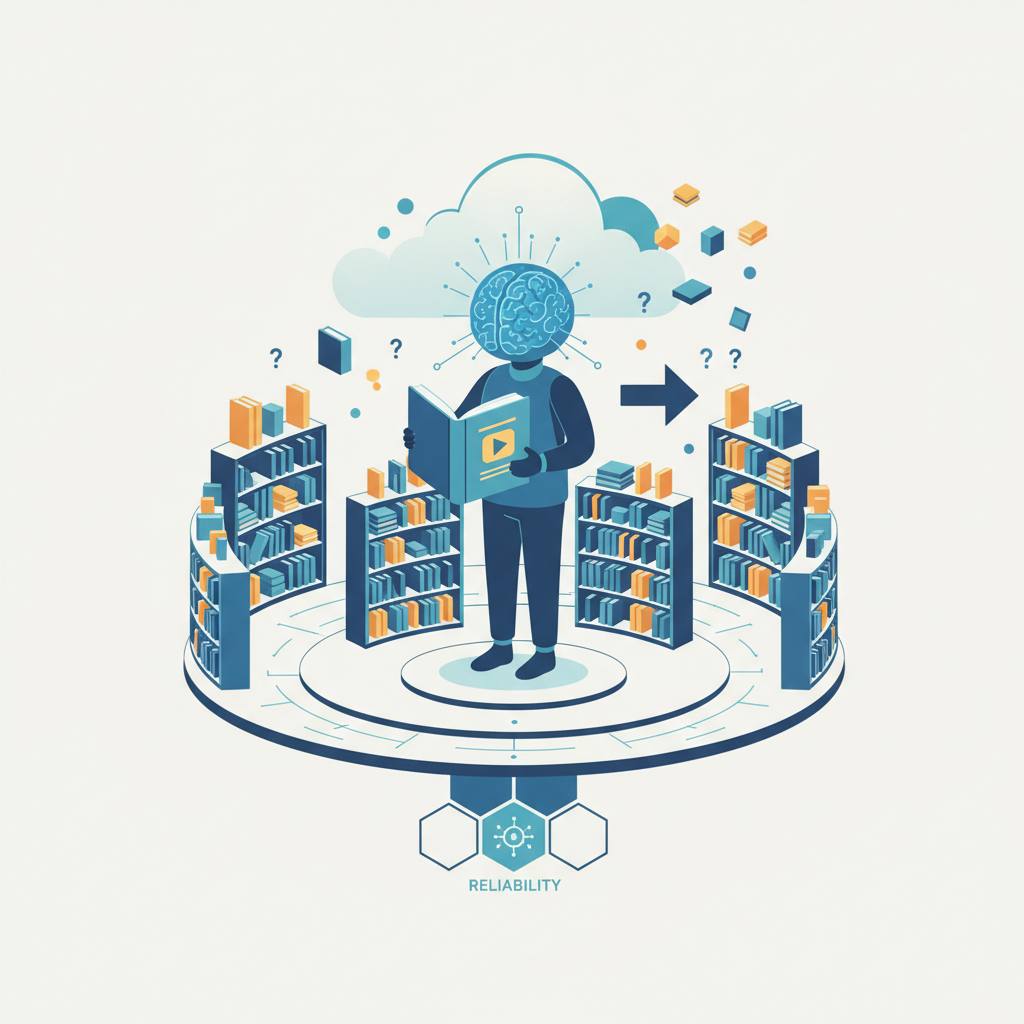
This is where Retrieval Augmented Generation (RAG) comes in. Imagine an LLM as a brilliant student who only answers from memory. If someone asks a difficult question requiring very specific or up-to-date information from particular books, this student might struggle or get it wrong.
Instead of letting the student answer solely from their memory, the RAG system provides them with a 'library' of relevant documents. When a question is asked, the RAG system first acts like a quick, efficient librarian. It searches this library to find the most relevant sections related to the question. This process involves three simple steps:
1. **Retrieve:** A separate system (not the LLM itself) quickly searches your database of documents to find pieces of information that seem highly relevant to your query.
2. **Stuff Context:** This retrieved information is then 'stuffed' or included as extra 'context' directly into the prompt given to the Large Language Model.
3. **Generate:** The LLM then uses its own vast knowledge *plus* this newly provided, specific context to generate a much more accurate and informed answer.
However, as the news hook points out, if the 'librarian' (the retrieval system) isn't very good, or if the documents in the library are poorly organized (e.g., a table split in half), the student might retrieve incorrect or incomplete information. This basic approach is what's sometimes called 'Naive RAG.'
To overcome these limitations, experts have developed more sophisticated RAG techniques. Think of these as 'advanced library management systems' – perhaps better indexing, a more intelligent librarian who refines the search, or even ways to verify the retrieved information *before* giving it to the student. These improvements turn RAG into a 'design space' with many patterns, ensuring the LLM gets the *best* possible context. By using RAG, AI answers become more accurate, less prone to 'hallucinations,' and are grounded in reliable, current facts directly from your own data sources, making them far more useful and trustworthy. At WondTech, we guide you through understanding and implementing these powerful techniques.
Large Language Models (LLMs) are incredibly smart and can generate human-like text. However, their knowledge is limited to the vast amounts of data they were trained on. This means they might 'hallucinate' (make up) answers, provide outdated information, or simply not know the specifics of *your* unique documents. Relying solely on an LLM's internal memory can lead to inaccurate or unhelpful responses, especially for complex or very specific queries.
This is where Retrieval Augmented Generation (RAG) comes in. Imagine an LLM as a brilliant student who only answers from memory. If someone asks a difficult question requiring very specific or up-to-date information from particular books, this student might struggle or get it wrong.
Instead of letting the student answer solely from their memory, the RAG system provides them with a 'library' of relevant documents. When a question is asked, the RAG system first acts like a quick, efficient librarian. It searches this library to find the most relevant sections related to the question. This process involves three simple steps:
1. **Retrieve:** A separate system (not the LLM itself) quickly searches your database of documents to find pieces of information that seem highly relevant to your query.
2. **Stuff Context:** This retrieved information is then 'stuffed' or included as extra 'context' directly into the prompt given to the Large Language Model.
3. **Generate:** The LLM then uses its own vast knowledge *plus* this newly provided, specific context to generate a much more accurate and informed answer.
However, as the news hook points out, if the 'librarian' (the retrieval system) isn't very good, or if the documents in the library are poorly organized (e.g., a table split in half), the student might retrieve incorrect or incomplete information. This basic approach is what's sometimes called 'Naive RAG.'
To overcome these limitations, experts have developed more sophisticated RAG techniques. Think of these as 'advanced library management systems' – perhaps better indexing, a more intelligent librarian who refines the search, or even ways to verify the retrieved information *before* giving it to the student. These improvements turn RAG into a 'design space' with many patterns, ensuring the LLM gets the *best* possible context. By using RAG, AI answers become more accurate, less prone to 'hallucinations,' and are grounded in reliable, current facts directly from your own data sources, making them far more useful and trustworthy. At WondTech, we guide you through understanding and implementing these powerful techniques.